If your boiler is not heating, check the thermostat, power and fuel, then read the gauge. Weil-McLain gives 12 psi as a typical cold pressure for a hot water boiler, and its relief valve opens at 30 psi. Burnham sets its steam boiler to shut off at 1 or 2 psi. Cold radiators with a running boiler point to low pressure, trapped air or a stopped circulator pump.
Hot water or steam: which boiler do you have?
Boilers are a minority heat source in the US. In the EIA's 2020 housing survey, 9.29 million of 123.5 million homes used a steam or hot water system as their main heat, about 7.5%. Of those, 6.51 million burned natural gas and 1.62 million burned fuel oil or kerosene. Almost half, 4.36 million, were apartments in buildings with two or more units.
The two types fail in different ways, so identify yours before you touch anything.
- Hot water (hydronic). The boiler has a round gauge that shows both pressure in psi and temperature. You will also see a circulator pump on the pipes and an expansion tank. Radiators have two pipes and a small bleed valve near the top. Copper fin-tube baseboard in a house is almost always hot water.
- Steam. The boiler has a glass tube on its side that shows the water level, plus a low-pressure gauge. A one-pipe steam radiator has a valve at one end and a small air vent on the other. The Burnham user manual says the lowest safe water level is marked on a plate next to the gauge glass.
Boiler not working: what to check first
Go in this order and stop when you find the problem. For the furnace version of these checks, see our no heat in the house guide.
- Thermostat. Set it to Heat, a few degrees above room temperature. A blank screen usually means dead batteries.
- Power. Check the breaker and the boiler's service switch, which looks like a light switch on or near the boiler. Some homes have a second switch at the top of the basement stairs.
- Fuel. If the gas stove or water heater will not light either, call the gas utility. With oil or propane, read the tank gauge.
- Lockout. An oil burner has a reset button on its control box. Press it once. Beckett says its GeniSys control goes into a restricted lockout after three lockouts without a completed heating call, "to prevent repetitious resetting by the homeowner." A gas boiler with a display shows a code. Write it down and look it up in the manual.
- Hot water gauge. Read it cold. Weil-McLain gives 12 psi as typical for a house. Each psi lifts water about 2.3 feet, so 12 psi reaches roughly 28 feet above the gauge. Much lower, and the top floor goes cold first.
- Steam water level. Look at the gauge glass. If you see no water, or it sits below the low-water mark, turn the boiler off. Weil-McLain warns, "Do not add cold water to a hot boiler," because thermal shock can crack it. Let it cool first.
- Radiator valves. Make sure they are open. On a one-pipe steam radiator, the valve "has to be wide open or completely closed," Contractor magazine explains. Condensate drains out the same pipe the steam comes in.
- Circulator pump. On hot water, the pump should run whenever the boiler fires for heat. Listen for a hum. If the boiler is hot but the pipe leaving the pump stays cold, water is not moving.
Boiler on but radiators cold: what each sign means
If the boiler fires but the house stays cold, where the heat stops tells you the likely cause.
| What you notice | Likely cause | What to do |
|---|---|---|
| Radiator warm at the bottom, cold at the top, gurgling | Air trapped in the radiator or baseboard | Bleed it (steps below) |
| Upstairs cold, downstairs warm, gauge under 12 psi cold | Not enough water in the system | Check the fill valve; call if pressure keeps dropping |
| Boiler hot, pipes past the pump cold | Circulator stopped or stuck, or a zone valve not opening | Call for service |
| One zone cold, others fine | That zone's thermostat, valve or pump, or air in that loop | Check the zone thermostat, then call |
| Gauge climbs near 30 psi hot, relief valve drips | Waterlogged or undersized expansion tank, per Weil-McLain | Call; never cap the relief valve |
| One steam radiator cold, others hot | Air vent stuck shut, or valve partly closed | Open the valve fully; have the vent checked |
| Steam pipes bang when heat comes on | Water trapped in pipes, or a radiator out of pitch | Open valves fully; call a steam tech if it continues |
| Steam burner will not fire, glass low | Low water cutoff stopped the burner | Let it cool, then refill to the normal line or call |
| Oil burner dead, red light on the control | Burner lockout | Press reset once; call if it locks out again |
How to bleed air from radiators and baseboard
This is for hot water systems only. Do not open anything on a steam radiator. Its vent lets air out by itself and closes when steam arrives, as Contractor magazine describes.
- Turn the thermostat down and let the system cool. Weil-McLain says to let the boiler cool before maintenance to avoid burns.
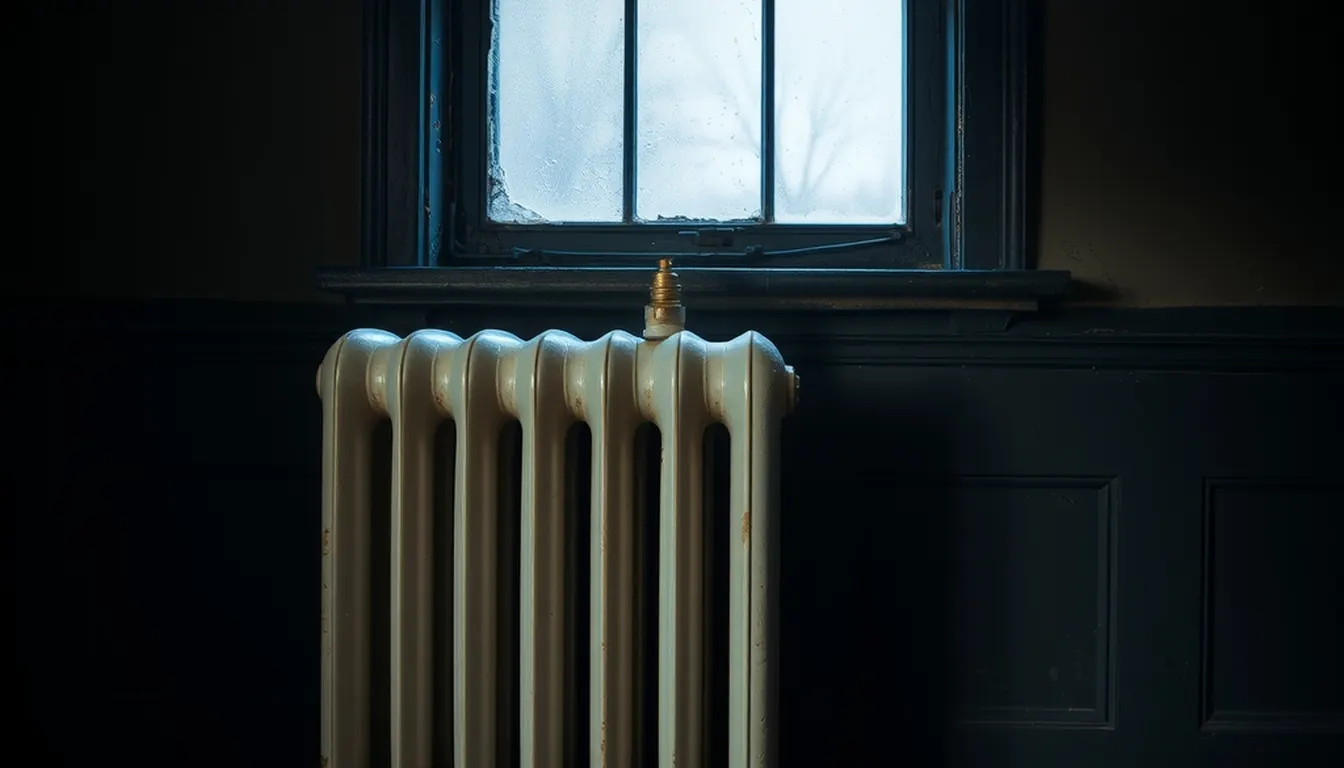
- Find the bleed valve. On a radiator it is a small square stem or screw near the top. On baseboard it is usually at one end, under the cover. A radiator key fits the square stem.
- Hold a cup or rag under it and open it slowly. You will hear air hiss.
- Close it when water comes out in a steady stream. Weil-McLain's manual says to open vents one at a time, "beginning with lowest floor," and to close each one "when water squirts out."
- Go back and read the boiler gauge. Bleeding swaps air for water, so pressure drops. If it is now below the cold fill pressure, the system needs water.
How to fix boiler pressure
Pressure too low
Most hot water systems have an automatic fill valve on the cold water line. It tops the system up to the cold fill pressure. If its supply valve was closed, or the fill valve is clogged, pressure falls. Add water only with the boiler cool, then find out why it was low.
Burnham's manual says that if you add water more than once a month, have a technician check for leaks. Fresh water brings minerals and oxygen. Burnham explains that sediment can build up until the cast iron overheats and cracks, and that oxygen can corrode it from the inside.
Pressure too high
Water expands as it heats. The expansion tank absorbs that with a cushion of air. When the tank loses its air, pressure climbs toward 30 psi and the relief valve discharges. Weil-McLain says "too high a rise would indicate a waterlogged or undersized expansion tank." It puts a diaphragm tank's air charge at usually 12 psi for homes. A tank that will not hold that charge has a damaged membrane and needs replacing.
If the gauge reads high even with the boiler cold, the fill valve may be letting in too much water. Either way, this is a service call.
Steam pressure
Steam heats at very low pressure. Burnham's Independence manual sets the pressure control to stop the burner at 2 psi, or at 1 psi with a 0.5 psi differential on other control models. Its user manual lists 15 psi as the maximum allowable. A steam gauge climbing toward 15 means the pressure control is not doing its job. Shut the boiler off and call.
Why is my boiler leaking water?
Find where the water comes from. That decides how urgent it is.
- From the relief valve pipe. This pipe runs down the side of the boiler. Weil-McLain requires it to end at least 6 inches above a floor drain, so any discharge is visible. Water here usually means pressure went too high, often because of the expansion tank. If pressure stays normal and it still drips, Weil-McLain says to replace a valve that weeps or will not seat.
- From fittings, valves or the pump. Weil-McLain says leaks must be "repaired at once," because constant fresh makeup water shortens boiler life.
- From the boiler body. Water from between cast iron sections or under the jacket can mean a cracked section. Have it inspected soon; a cracked section may not be repairable.
Never plug or cap the relief pipe. Weil-McLain warns that blocking it can stop the valve from working, with a risk of "severe personal injury, death or substantial property damage." It says a licensed plumbing contractor or inspection agency, not the owner, should reinspect relief valves at least once every three years.
Why is my boiler making noise?
- Gurgling or trickling in pipes and radiators. Air in a hot water system. Bleed it, then check the pressure.
- Banging in steam pipes. Water hammer. Contractor magazine says a partly closed one-pipe radiator valve causes "water hammer and uneven heating." Radiators also drift out of pitch over time. The vent end should sit a little higher than the valve end so water drains back.
- Rumbling or a kettle sound from the boiler. Water flashing to steam on a hot spot. Burnham's manual explains how hot spots form: sediment from fresh water "can eventually isolate the water from contacting the cast iron," and that area "gets extremely hot and may eventually crack." Have it checked.
- Hissing at the relief valve. Too much pressure. Read the gauge and call.
- A humming pump with no heat. The motor may run while the pump is stuck or full of air. That needs a technician.
Why is my boiler not heating water for the taps?
Many boilers heat tap water too. A tankless coil sits inside the boiler itself. An indirect water heater is a separate tank, heated by boiler water through a coil, with its own thermostat and its own zone valve or pump.
If the radiators heat but the taps run cold, the boiler is firing. Look at the hot water side: the tank thermostat setting, its zone valve or pump, or a coil clogged with scale. If both heat and hot water are out, start with the checks above. A combi boiler, which heats tap water on demand, shows a code on its display; look it up in the manual.
Boiler not working after a power cut
A gas or oil boiler still needs electricity for its controls, igniter and pump. It may not restart on its own. Burnham's user manual warns that its boiler "contains controls which may cause the boiler to shut down and not restart without service."
- Check the breaker and the boiler service switch.
- Check the thermostat. Replace batteries, and make sure a smart thermostat came back on and is set to Heat.
- On oil, press the burner reset once. On gas, read the display code.
- If the outage came with flooding, stop. Burnham says not to use a boiler if any part has been under water, and to have a qualified technician replace any control or gas control that was.
If you will be away in cold weather, Burnham says not to leave the system unattended in cold weather unless you install safeguards and alarms that warn you if the boiler stops. Frozen water expands and can split pipes and radiators.
What boiler repairs cost
Reported ranges differ by source. Fixr puts most boiler repairs at $150 to $750, with a national average of $450, on a page updated January 2026. Homeyou reports an average of $506 and a range of $171 to $1,004, updated July 2026. Fixr puts a full boiler replacement at an average of $6,100.
| Repair | Fixr | Homeyou |
|---|---|---|
| Circulator pump | $300 to $1,100 | $393 to $855 |
| Expansion tank | $200 to $800 | Not listed |
| Zone or boiler valve | $175 to $500 | Not listed |
| Pressure relief valve | Not listed | $240 to $481 |
| Leak repair | $175 to $800 | Not listed |
| Thermocouple | $100 to $400 | Not listed |
| Tune-up or inspection | $200 to $500 (tune-up) | $171 to $340 (inspection) |
Fixr's page gives two tune-up figures: $200 to $500 in the text and $150 to $500 in its FAQ. Bleeding radiators and reading the gauge cost nothing. Before a large repair, get two written quotes. Our guide on how to compare HVAC quotes covers what to ask.
Is $8,000 reasonable to replace cast iron radiators?
It depends on how many. Fixr reports an average of $1,500 to replace one radiator, with most jobs between $1,000 and $3,500. It puts plumbed labor at $600 to $800 for 3 to 4 hours, and removal and disposal at $250 to $400. Its high-end example, replacing every steam radiator in a house, is $8,600.
So for one or two radiators, $8,000 is above Fixr's high end. For a whole house, it is close to Fixr's example. Ask what actually failed. A leaking valve or air vent is a smaller job than the radiator itself. Ask for the number of radiators, the size of each, and parts and labor on separate lines.
Why are old hot water pipes so large?
Many older hot water systems were built without a pump. Weil-McLain's manual calls them "converted gravity systems," large-volume systems "originally designed for circulation by natural convection rather than a pump." Hot water rose on its own and cooler water sank back to the boiler. Wide pipes have less friction, so that slow flow could reach every radiator.
Those systems hold a lot of water, so they take longer to warm up. Weil-McLain gives separate piping instructions for them. Tell any contractor quoting a new boiler that yours is a converted gravity system.
Safety limits: when not to touch it
- Gas smell. The Burnham user manual says not to light any appliance, touch any electrical switch, or use any phone in the building. Call the gas supplier from a neighbor's phone, or the fire department if you cannot reach them.
- Carbon monoxide. CPSC lists headache, dizziness, weakness, nausea, vomiting, sleepiness and confusion as symptoms. If you suspect CO, get outside and call 911. CPSC recommends CO alarms on every level of the home and outside sleeping areas.
- Overheating, or gas that will not shut off. Weil-McLain says not to cut power to the circulator. Shut off the gas at a valve outside the boiler instead.
- Relief valve. Never cap or plug it.
- Flood. Burnham says not to use a boiler if any part has been under water.
- Steam with no water in the glass. Shut it off and let it cool.
Plan a yearly service. Weil-McLain tells owners to have the boiler "serviced/inspected by a qualified service technician, at least annually." ENERGY STAR suggests checking the heating system in the fall, before contractors get busy. If your steam boiler has a float-type low water cutoff (McDonnell & Miller 67), Burnham says to flush it weekly, following the card on the boiler jacket. The water comes out hot.
If you rent
Nearly half of US boiler homes are apartments, per the EIA figures above, so the repair is often the landlord's job. Report the problem in writing. In New York City, NYC311 says that from October 1 through May 31, indoor heat must be at least 68°F from 6 AM to 10 PM when it is below 55°F outside, and at least 62°F overnight. Hot water must stay at a minimum of 120°F all year. Other cities set their own rules.
Call a pro now if
- You smell gas or a CO alarm sounds. Call from outside.
- The relief valve is discharging, or a hot water gauge reads near 30 psi.
- A steam gauge climbs well past 2 psi, or there is no water in the gauge glass.
- The oil burner locks out again after one reset, or a gas boiler shows the same code twice.
- Water is coming from the boiler body, or you are adding water more than once a month.
- The circulator hums but the pipes past it stay cold.
- The house is getting cold enough to freeze pipes and you cannot restore heat.
- Any part of the boiler has been under water.
Questions people ask
What should the pressure be on my boiler?
On a hot water boiler, Weil-McLain gives 12 psi as a typical cold reading for a house. It rises as the water heats but should stay well under the 30 psi relief valve. Steam runs far lower: Burnham's manual sets the burner to shut off at 1 or 2 psi, and lists 15 psi as the maximum allowable.
Can I add water to my boiler myself?
On a hot water system, the automatic fill valve normally does it. On a steam boiler, you can refill to the normal water line marked on the boiler, but only after it cools. Weil-McLain warns not to add cold water to a hot boiler, because thermal shock can crack it. Burnham says to have the system checked for leaks if you add water more than once a month.
Should I bleed steam radiators?
No. A steam radiator has an automatic air vent that lets air out and closes when steam reaches it. If one steam radiator stays cold, open its valve fully and have the vent checked. Bleeding with a radiator key is for hot water radiators and baseboard only.
Why does my boiler keep losing pressure?
Water is leaving the system. Look for drips at the relief valve pipe, pump flanges, valves and radiator bleeders, and ask whether someone bled radiators without topping up. If you add water more than once a month, Burnham's manual says to have a technician check for leaks, because fresh water brings minerals and oxygen that shorten boiler life.
How often should a boiler be serviced?
Weil-McLain tells owners to have the boiler serviced or inspected by a qualified technician at least once a year, and ENERGY STAR suggests booking heating checks in the fall. If a steam boiler has a McDonnell and Miller 67 float low water cutoff, Burnham says the owner should flush it weekly, following the card on the boiler.
Sources
- Weil-McLain: CGa Series 4 Gas-Fired Water Boiler Manual (550-100-223/0425)
- U.S. Boiler Company (Burnham): Independence Steam Boiler Installation, Operating and Service Instructions (103538-10)
- Burnham: Independence User's Information Manual (103539-01, copy hosted by Boston Heating Supply)
- Beckett: GeniSys 7575 Oil Primary Control product sheet
- Contractor magazine: Things at the end of a one-pipe steam radiator (Patrick Linhardt, 2024)
- U.S. Energy Information Administration: RECS 2020 Table HC6.1, Space heating in U.S. homes
- CPSC: Carbon Monoxide Information Center
- ENERGY STAR: Maintenance Checklist
- NYC311: Heat or Hot Water Complaint
- Fixr: How Much Does It Cost to Repair a Boiler?
- Homeyou: Boiler Repair Cost
- Fixr: How Much Does It Cost to Replace a Radiator?