When the house has no heat, start with the checks furnace makers list before a service call: thermostat mode and batteries, the breaker and furnace switch, the filter, the gas supply, and the blinking code on the control board. Go in that order. If you smell gas or a carbon monoxide alarm sounds, skip all of it, get everyone outside, and call from there.
No heat in the house: what to check first
This order follows the "before you request a service call" checklist in a Carrier condensing furnace owner's manual, plus heat pump steps from Carrier, Trane and Lennox. Stop at the first thing you find wrong, fix it, and wait through one heating cycle.
- Thermostat mode. Set it to Heat and a few degrees above room temperature, as Lennox advises. Set the fan to Auto. With the fan on On, Carrier says the blower runs continuously, so you feel unheated air between cycles.
- Thermostat screen. Blank means dead batteries or no power from the system. Trane suggests new batteries once a year.
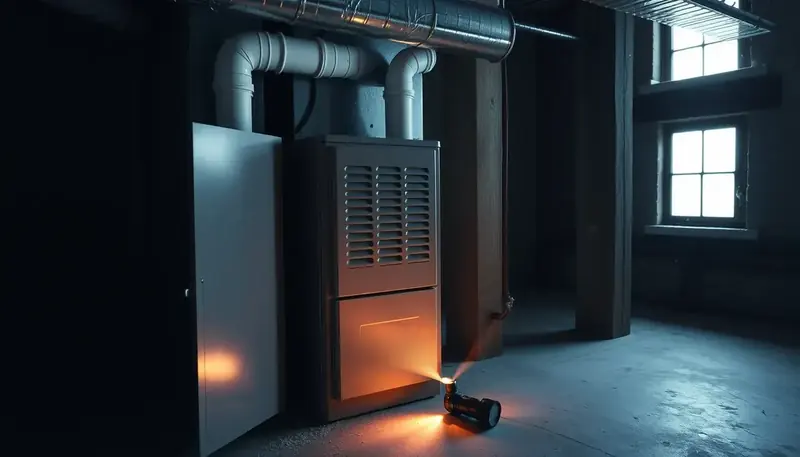
- Breaker and furnace switch. Look for a tripped breaker labeled furnace, air handler or heat pump. Bryant says reset it once and call a professional if it trips again. Then check the service switch near the furnace. It looks like a light switch.
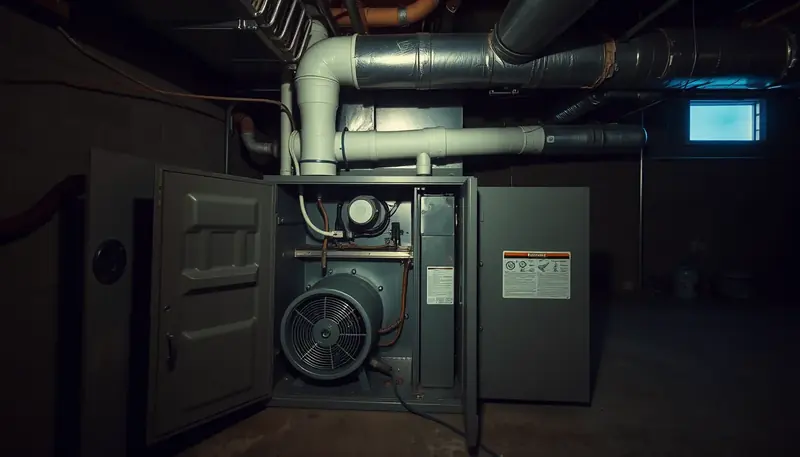
- Furnace door. The blower door presses a safety interlock switch, which Carrier lists among the furnace parts. If the door is off or loose, the furnace will not start.
- Filter. Carrier says a dirty filter can make the furnace overheat and shut itself down. Replace it, and never run without one.
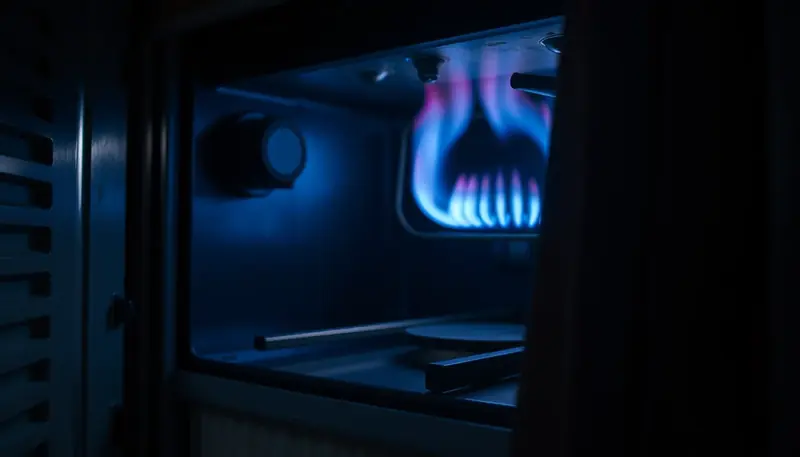
- Gas. The valve on the gas pipe to the furnace should be open, handle in line with the pipe. If the stove will not light either, call the gas utility. On propane, read the tank gauge.
- Vent pipes outside. High-efficiency furnaces vent through plastic pipes on a wall or roof. Carrier says to check the vent ends for obstructions, and the propane industry's safety guide names snow, ice and nests. Clear snow by hand.
- Condensate. Those furnaces make water. Bryant says a blocked drain line can trip a float switch that stops the furnace. Look for water at the base or a full condensate pump.
- Blinking light. Count the flashes through the small window in the lower door before you turn anything off. Carrier warns that cutting power or opening the blower door erases the code.
- Heat pump outdoor unit. Steam and a stopped fan for a few minutes is defrost. Thick ice that stays is not.
Boiler homes get the same thermostat, power and gas checks. Then compare the boiler's pressure and temperature gauge with the range in its manual.
Why is my house not heating up? What each sign means
If the basics check out, watch what happens when someone raises the setpoint. Where the system stops tells you a lot.
| What you see | What it can mean | What to do |
|---|---|---|
| Thermostat calls for heat, furnace silent | Breaker tripped, service switch off, or door interlock open | Check all three, then call |
| Inducer fan hums, igniter never glows | Pressure switch not proving draft: blocked vent, condensate, failed switch or inducer | Clear the vent ends; read our pressure switch guide |
| Flame lights, then goes out within seconds | Dirty or failing flame sensor, per Trane and Bryant | Book a technician |
| Burners run a few minutes, shut off, restart | Overheating from a dirty filter or closed grilles | New filter; open supply and return grilles |
| Blower runs, air is cool | Fan set to On, burners not lighting, or heat pump defrost | Fan to Auto; read the code |
| Ice on the heat pump that stays after defrost | Airflow, refrigerant or defrost fault, per Carrier | Emergency heat, then call |
| Water on the floor by the furnace | Blocked condensate drain or failed pump | Call; never bypass the float switch |
Furnace turns on, flame goes out
A gas furnace starts in a fixed order. In the Carrier manual, the inducer fan starts first and a pressure switch confirms combustion air. The hot surface igniter heats for 17 seconds, the gas valve opens, and the burners light. About 60 seconds later the blower starts. Timings differ by model.
If it stops before the igniter glows, the pressure switch did not see enough draft. Our inducer and pressure switch guide covers the causes.
If the burners light and die within seconds, the furnace did not prove the flame. Trane says a dirty or faulty flame sensor can shut it off early, and also lists a dirty filter, dirty burners and the control board. Bryant says a furnace that keeps starting and stopping needs a qualified technician.
Lockouts and the reset question
After repeated failed starts, the control stops trying. Carrier's manual says its furnace locks out after four failed attempts and tells you to call your dealer. Trane describes soft lockouts, then a hard lockout on the third failure that a technician must clear.
So reset once, after you record the code: furnace switch off, wait a moment, back on. If it fails again, stop. Lennox warns that repeatedly cycling a system can cause more damage.
Reading the blinking light
Count the flashes, note the color, and take a short phone video. Match the pattern to the chart inside the door or in the manual. Bryant says not to assume a code means the same thing across models, so skip code lists for other brands.
The rollout switch
Carrier's checklist includes a manual-reset flame rollout switch on the burner box. It shuts the furnace off after high temperatures. Carrier says to push its button once, and if it trips again, shut down and call. Causes a technician checks can include a blocked vent or a damaged heat exchanger. See our cracked heat exchanger guide.
Heat pump not heating: defrost, aux heat and emergency heat
In cold, damp weather the outdoor coil frosts, and the heat pump reverses briefly to melt it. Trane says defrost usually lasts 3 to 5 minutes; Carrier says about 5 to 10. The outdoor fan may stop and steam can rise. Trane calls that normal, and says homes without backup heat may feel cool air from the vents meanwhile.
Carrier says heat pump air runs about 85 to 100°F, cooler than furnace air, so it can feel lukewarm and still be heating. Ice is different. Carrier says ice thicker than 1/4 inch, or ice that stays after defrost, is not normal. The EPA requires Section 608 certification for anyone servicing equipment that could release refrigerant, so that is a service call.
Aux heat and emergency heat
Aux heat is the automatic backup, usually electric strips or a gas furnace. Trane says it comes on below 40 degrees outside, during defrost, or when you raise the setpoint more than 3 to 4 degrees. Trane says AUX showing for more than an hour or two above 40 degrees is worth investigating.
Emergency heat is a manual setting that shuts off the heat pump and runs only the backup. Lennox says to use it when a technician tells you to, when the heat pump has failed, or when the outdoor unit is frozen solid or damaged. Carrier says to use it sparingly because resistance heat can raise the bill a lot. Trane says to call for service right away.
Aux heat won't turn on, or emergency heat is not working
If AUX never comes on in deep cold, or emergency heat blows cool air, the backup has a problem. Carrier notes that the indoor and outdoor units have separate breakers, so check the indoor air handler's breaker and reset it once. If the backup is a gas furnace, use the furnace checks above. Trane also says to confirm the thermostat is a compatible heat pump model.
Heat is on but the house is cold
Check airflow first. Carrier's weak-airflow checklist has two items: a dirty filter, and supply or return grilles that are closed or blocked by furniture. Set the fan to Auto. On a heat pump, if the house keeps losing ground while AUX shows, the backup may not be working.
Gas smell or CO alarm: when to stop
Connecticut's utility regulator adds: do not adjust thermostats, and never turn gas back on yourself after a safety shutoff. The propane industry's safety guide says a qualified professional must leak check the system when gas goes back on after a run-out. Never open the tank valve yourself.
Carrier calls carbon monoxide invisible, odorless and toxic. The CPSC says more than 200 people in the United States die each year from accidental non-fire CO poisoning. Symptoms include headache, dizziness, weakness, nausea, vomiting, sleepiness and confusion. If you suspect CO, get outside to fresh air, then call 911. The CPSC says to put CO alarms on every level and outside sleeping areas.
No heat for a few days: protect pipes and people
Pipes
- Open kitchen and bathroom cabinet doors so warm air reaches the plumbing, and move cleaners out of children's reach. This and the steps below come from the Red Cross.
- Let cold water drip from faucets on exposed pipes. Even a trickle helps.
- Keep the garage door closed if water lines run through it.
- If a faucet only trickles, suspect a frozen pipe. Keep it open and warm the pipe with a hair dryer, heating pad or hot towels. Never use an open flame. Call a licensed plumber if you cannot reach the frozen section.
If the furnace sits in an unheated attic or garage, ask about freeze protection. Carrier says a condensing furnace that has run holds water and cannot be left off for long at 32°F or below unless winterized.
People
- Close off unused rooms, stuff towels under doors, and cover windows with blankets at night, as the CDC recommends.
- The CDC says people over 65 should check the indoor temperature often in extreme cold.
- For babies, it advises footed pajamas, wearable blankets or sleep sacks, and no pillows or soft bedding.
- Hypothermia signs include shivering, confusion, fumbling hands, slurred speech and drowsiness. In babies, the CDC lists bright red, cold skin and very low energy. A body temperature below 95°F is an emergency.
Safe temporary heat
- The NFPA tip sheet says to keep electric space heaters at least 3 feet from anything that can burn, plug them directly into a wall outlet, never an extension cord, and turn them off when you leave the room or go to bed.
- Do not heat with the stove or oven. The CDC says it is not safe.
- The CPSC says generators belong outside only, at least 20 feet from the house, exhaust pointed away.
No heat in my apartment
If you rent, heat is usually the landlord's job. Do the thermostat checks, then report the problem in writing. Rules vary by state and city. In New York City, NYC311 says owners must provide heat from October 1 through May 31. From 6 a.m. to 10 p.m., the inside must be at least 68°F when it is below 55°F outside. Overnight, it must be at least 62°F. Tell the landlord or super first, then file a complaint.
What a no-heat repair costs
Price guides disagree, so treat these as rough national ranges. Fixr, updated August 2025, reports a $485 average for furnace repair, typically $349 to $650. Inch Calculator, last updated in 2023, puts gas, oil and propane furnace repairs at $300 to $1,200. Fixr says after-hours and holiday calls cost more but gives no figure.
| Repair | Fixr (service call plus part) | Inch Calculator |
|---|---|---|
| Igniter | $96 to $178 | $175 to $300 |
| Flame sensor | $68 to $127 | $80 to $250 |
| Control board | $390 to $725 | $300 to $650 |
| Blower motor | $562 to $1,045 | $250 to $900 |
| Gas valve | Not listed | $675 to $1,300 |
| Heat exchanger | $1,346 to $2,673 | $500 to $3,500 |
For heat pumps, Fixr (updated January 2026) reports most repairs at $150 to $650, averaging $400. It lists a service call at $75 to $250, a capacitor at $100 to $400 and a circuit board at $150 to $700.
A heat exchanger finding can turn into a replacement pitch fast. Read the cracked heat exchanger guide for the evidence to ask for, and our guide to HVAC quotes before you sign.
Call a pro now if
- You smell gas or hear hissing. Leave, then call from outside.
- A CO alarm sounds, or anyone has a headache, dizziness, nausea or confusion. Get outside, then call 911.
- The furnace locks out again after one reset, or the rollout switch trips twice.
- A breaker trips again after one reset, or you smell burning plastic.
- Thick ice stays on the heat pump, or emergency heat gives no warm air.
- Water is pooling at the furnace.
- You ran out of propane.
- The house keeps getting colder and someone inside is an infant, older or ill. Ask the after-hours rate when you call.
When you call, have the furnace brand and model, the blinking code, and what you already checked. Ask whether the diagnostic fee counts toward the repair.
Questions people ask
Is no heat in the house an emergency?
It is an emergency if you smell gas, a carbon monoxide alarm sounds, anyone has CO symptoms, or the house is getting cold enough to put an infant, an older adult or your pipes at risk. Otherwise, run the basic checks first. A thermostat on the wrong mode, a tripped breaker or a clogged filter costs little or nothing to fix.
Can I reset my furnace myself?
Once. Write down the blinking code first, because Carrier says cutting power erases it. Then turn the furnace switch off and back on. If it fails again, stop. Lennox warns that repeated cycling can cause more damage, and Trane says a furnace in hard lockout needs a technician to fix the cause and reset it.
Should I turn on emergency heat?
Only if the heat pump itself has failed, a technician tells you to, or the outdoor unit is frozen solid or damaged. That is how Lennox describes it. Emergency heat runs only the backup, such as electric strips, and Carrier says that can raise the electric bill a lot. Trane says that if you switch it on, call for service right away.
Why is my furnace blowing cold air?
Check the thermostat fan setting first. With the fan on On, the blower runs nonstop and moves unheated air between cycles. If the fan is on Auto and the air is still cold, the burners are not lighting or are shutting off early, so check the filter, the gas supply and the blinking code. A heat pump in defrost can also blow cool air for a few minutes.
Can I heat my house with the oven?
No. The CDC says turning on the stove for heat is not safe. Use an electric space heater instead. The NFPA says to keep it at least 3 feet from anything that can burn, plug it straight into a wall outlet with no extension cord, and turn it off when you leave the room or go to bed.
How do I keep pipes from freezing with no heat?
The Red Cross says to open kitchen and bathroom cabinet doors, let cold water drip from faucets on exposed pipes, and keep the garage door closed if water lines run through it. If a faucet only trickles, a pipe may be frozen. Warm it with a hair dryer or heating pad, never an open flame.
Sources
- Carrier: Condensing Gas Furnace Owner's Manual (catalog OM58-125)
- Bryant: Furnace Not Turning On? Causes and Fixes
- Lennox: Thermostat Not Turning Heat On
- Trane: Thermostat Says Heat On but Furnace Not Running
- Trane: Furnace Main Burner Shuts Off After Ignition
- Trane: Solving Furnace Hard Lock Out Issues
- Trane: What Is a Heat Pump Defrost Cycle?
- Trane: What Is Auxiliary Heat in a Heat Pump System?
- Carrier: Heat Pump Not Heating? Troubleshooting Cold Air Issues
- Lennox: What Is Emergency Heat and When to Use It
- EPA: Section 608 Technician Certification
- CPSC: Carbon Monoxide Information Center
- Connecticut PURA: What to Do If You Smell Natural Gas
- Propane Education and Research Council: Safety Guide for Propane Users
- American Red Cross: Preventing and Thawing Frozen Pipes
- CDC: Safety Guidelines During and After a Winter Storm
- NFPA: Electric Portable Space Heater Safety tip sheet (copy hosted by Liberty County, GA)
- NYC311: Heat or Hot Water Complaint
- Fixr: How Much Does a Furnace Repair Cost?
- Fixr: How Much Does Heat Pump Repair Cost?
- Inch Calculator: Furnace Repair Cost Guide