A furnace pressure switch lets the burners light only after the inducer motor has pulled enough draft through the vent. When the switch stays open, the inducer runs, nothing lights, and the control board flashes a code. The usual causes are a blocked vent or intake, a backed-up condensate drain, a cracked or wet hose, or a weak inducer. The switch itself is rarely the root problem.
You can safely read the code, check the outdoor pipes for snow or nests, check the condensate drain, and change the filter. Do not jump the switch to get heat. HomeGuide reports $150 to $400 to replace a pressure switch and $400 to $1,100 for an inducer motor. If a carbon monoxide alarm sounds or you smell gas, get out first and troubleshoot later.
How does a furnace pressure switch work?
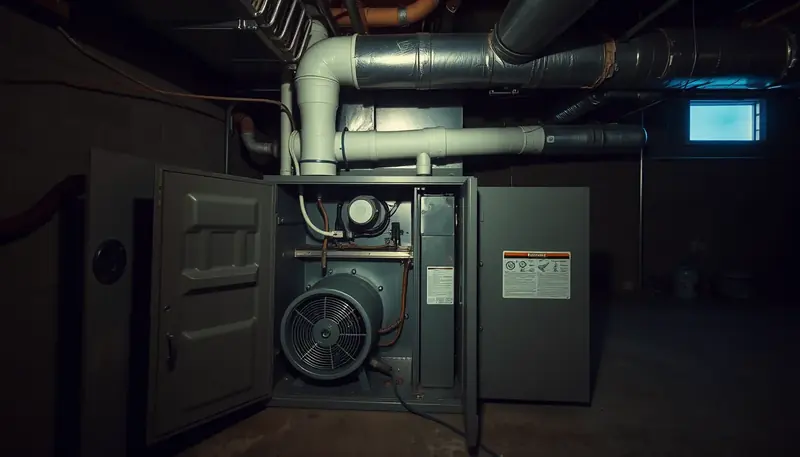
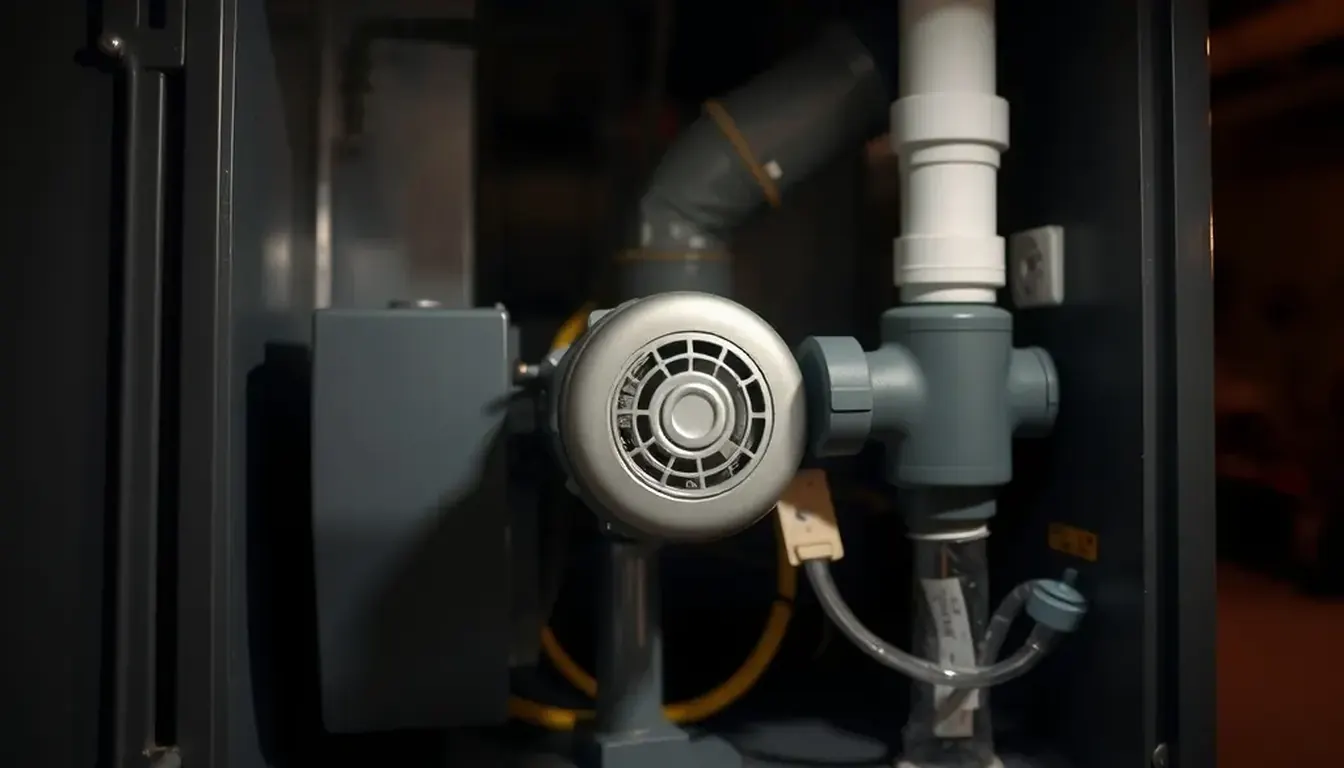
On a call for heat, the control board checks its safety switches, then starts the inducer: a small motor and fan wheel bolted to the side of the heat exchanger. The inducer pulls air through the heat exchanger and pushes exhaust out the vent pipe. That suction also pulls on a thin rubber hose that runs to the pressure switch. When the suction is strong enough, a diaphragm inside the switch closes its contacts.
Only then does the furnace move on. Carrier's troubleshooting guide for its two-stage furnaces lists a 15-second prepurge once the switch closes, then a 17-second igniter warm-up, then the gas valve opens. Goodman's installation manual describes the same order. It says the switches guard against "insufficient airflow (combustion air and flue products) through the heat exchanger and/or blocked condensate drain conditions."
The switch is tested in the other direction too. Carrier's control verifies the contacts are open before it starts the inducer, and Rheem's service note says the same check runs before any heat cycle. So a switch can fail two ways: stuck open, where it never closes, or stuck closed, where it never opens. Each sets its own code.
Two-stage furnaces often have two switches, one for low heat and one for high heat. Carrier calls the second one the high-heat pressure switch. That is not the "high pressure switch" on an air conditioner, covered under costs below.
What the blink codes mean
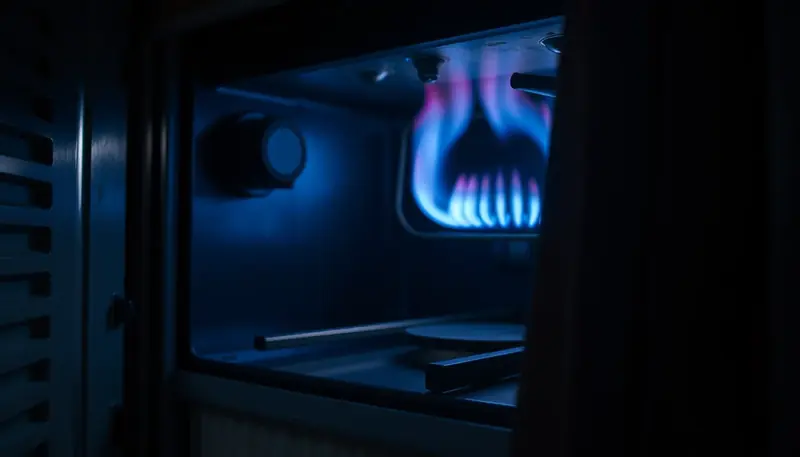
Look for a small window in the lower furnace door. The light behind it is the control board's status LED. Count the flashes before you open anything. Carrier's guide notes that power reaches the control only through a switch pressed by the blower door, and that its board erases stored codes after 48 hours or whenever power is interrupted. Film the light with your phone first.
Codes differ by brand and even by model. The legend is usually printed on a label inside the door. Bryant's troubleshooting guide points technicians to the "Service Label on blower access panel." These examples come from manufacturer documents:
| Brand and board | Code | What the manual says |
|---|---|---|
| Trane and American Standard (installer guide 18-CD21D1) | 3 flashes | Draft pressure error: a venting problem, pressure switch problem, or inducer problem |
| Carrier and Bryant two-stage | 32 (3 short, then 2 long flashes) | Low-heat pressure switch did not close or reopened |
| Carrier and Bryant two-stage | 31 | High-heat pressure switch or relay did not close or reopened |
| Carrier and Bryant | 23 | Pressure switch did not open: obstructed tubing or a switch stuck closed |
| Carrier and Bryant variable-speed | 42 | Inducer motor fault: no start within 20 seconds, or speed out of range |
| Goodman and Amana (displays vary) | See door label | Symptom listed as "induced draft blower runs continuously with no furnace operation" |
On Carrier and Bryant boards, the first digit is the number of short flashes and the second is the number of long flashes. HVAC School's write-up uses Carrier code 31 for a switch that did not close, which shows how much codes vary between boards. Trust your own door label over any chart, including this one.
On the Carrier two-stage furnaces in its guide, if the low-heat switch does not close within 5 minutes, the control shuts down and waits 15 minutes before retrying. That is why the furnace can seem to come back to life on its own.
What each symptom usually means
These causes come from the Bryant, Goodman, and Trane charts above and HomeGuide's list of inducer failure signs.
| What you notice | Likely cause | Who checks it |
|---|---|---|
| Inducer runs, nothing lights, light flashes | Switch not closing: blocked vent or intake, plugged condensate drain, hose problem, weak inducer, or a failed switch | You: pipes, drain, hose. Pro: draft reading, switch, inducer |
| Burners light, run briefly, shut off, then retry | Switch dropping out mid-cycle: water in a sagging vent pipe, a partly clogged trap, or high wind | You: drain and outdoor pipes. Pro: vent slope |
| Runs only when a cap or hose is pulled off the drain | Water backing up in the drain fittings or a clogged trap | Pro, unless your manual shows the trap as owner-serviceable |
| No inducer sound at all, or a hum with no spin | Failed inducer motor, or no power reaching it | Pro |
| Rattle, screech, or loud hum right after startup | Worn inducer bearings or a loose, unbalanced fan wheel | Pro |
| Code says the switch did not open | Switch stuck closed or obstructed tubing | Pro |
| Main blower runs, burners stay off, a limit code flashes | Airflow problem such as a clogged filter, not the pressure switch | You: filter |
Bryant's guide says a high-heat switch that makes, then breaks several times at the start of a cycle points to "a sag in vent pipe or a clogged drain trap or line." Its list for code 32 also includes excessive wind and a restricted combustion air supply.
HVAC School's author calls a failed switch the "most uncommon of all" causes. A new switch will not fix a blocked vent or a full trap, so the same code comes back.
How to fix a furnace pressure switch stuck open: safe checks first
- Record the code. Count the flashes through the door window, or film them. Match them to the label inside the door.
- Watch one start. Raise the thermostat a few degrees. Listen for the inducer whoosh, then look for the igniter glow and the burners. Note where it stops. If the inducer runs for a minute and nothing else happens, the switch is not closing.
- Check the outdoor pipes. Two white plastic pipes out the side wall or roof usually mean a high-efficiency, condensing furnace. One brings in combustion air and one carries exhaust out; Goodman's chart lists a blocked flue or inlet air pipe as a cause. The Town of Geddes, NY passes on fire department advice to clear snow off these vents, and warns that drifting snow can cause trouble before the snow line reaches them. Look for ice, leaves, and nests. Clear what you can reach at the opening. Do not push tools deep into the pipe.
- Check the condensate drain. On a condensing furnace, follow the drain tubing to the floor drain or condensate pump. Look for kinks, a line frozen where it runs outside, or a pump full of water. HVAC School notes that frozen outdoor condensate lines cause lockouts. Only take the trap apart if your owner's manual shows how. Goodman's GRVM97 manual says the drain trap must be primed, meaning filled with water, so refill it if you empty it.
- Look at the switch hose. With the power off, find the small round switch near the inducer. Its rubber hose should be on both ends, with no cracks, kinks, or water inside. Goodman's manual says the tubing must stay at least one inch from the flue pipe and other hot surfaces.
- Change the filter. A clogged filter trips a different safety, but it takes two minutes to check. ENERGY STAR recommends inspecting, cleaning, or changing filters once a month.
- Reset once. Turn the furnace power switch off for a minute, then back on. Carrier's guide says an ignition lockout resets after 3 hours or when power is briefly interrupted. If the same code comes back, stop and call for service.
Why you should never jump the pressure switch
Online advice sometimes says to bridge the switch terminals with a jumper wire to get heat for the night. Don't. A jumper tells the board there is draft when there may be none. If the vent is blocked by snow, a nest, or water, the burners light anyway. The exhaust then has no path out except into the house.
That exhaust carries carbon monoxide. The Consumer Product Safety Commission says about 170 people in the US die each year from CO produced by non-automotive consumer products, including malfunctioning furnaces. CO has no color and no smell. Its early symptoms feel like the flu without the fever.
Manufacturers treat a bypass as tampering. Rheem's service note lists "pressure switch physically bypassed in the field" as a fault cause. It tells technicians to remove the bypass, find out why it was done, and "notify homeowner and proper authorities of illegal tampering if necessary." HomeServe adds that pressure switches are calibrated safety devices that get replaced, not repaired.
Furnace inducer motor problems: weak, noisy, or dead
A dead inducer is easy to spot: no whoosh at the start of the cycle, or a hum with no spin. Carrier's chart has the technician ask whether the inducer turned on at all, check for 115 volts at its plug, and then "replace inducer motor or inducer motor assembly" if power is there.
A weak inducer is harder. It spins and sounds normal but cannot pull enough suction to close the switch, or holds it closed only until the furnace warms up. HomeGuide lists the signs of a failing inducer: rattling or vibration soon after startup, a hiss, a loud hum or screech, and a furnace that starts and then stops suddenly. HVAC School adds rising amperage and overheating. A technician confirms a weak inducer with a manometer on the switch tubing and compares the draft to what the switch needs.
Replaced the inducer and it still flashes
A new inducer cannot clear a plugged drain, water in a sagging vent, or a disconnected or blocked hose, and Bryant's chart lists all of those under the same code. After an inducer swap, check that the switch hose went back on the right port and is not kinked or touching the flue pipe. The same logic applies when a new aftermarket inducer seems to fail within a day. Confirm the vent and drain before blaming the part.
Can you replace an inducer motor yourself?
It is a bolt-on part: a few screws, a gasket, a wiring plug, and the switch hose. HomeGuide says the job takes 30 to 60 minutes, and that DIY saves $300 to $600 in labor but typically voids warranties. The risk is the seal. The gasket between the inducer and the collector box, and the vent joint above it, carry exhaust. A poor seal leaks flue gas into your house. Goodman's manuals open with a warning that only trained personnel should install, service, or repair the furnace.
Furnace pressure switch and inducer motor replacement cost
Published ranges vary, and even one publisher's pages disagree. HomeGuide's pressure switch page puts the part at $50 to $200, while its inducer page says a pressure switch part costs $15 to $80.
| Repair | Reported cost | Source |
|---|---|---|
| Pressure switch, installed | $150 to $400 (part $50 to $200, labor $100 to $200) | HomeGuide |
| Pressure switch, installed | $250 to $350 (part $30 to $50, labor $220 to $300) | Family Handyman, via HomeServe |
| Inducer motor, installed | $400 to $1,100 (assembly $100 to $500, labor $300 to $600) | HomeGuide |
| Draft inducer motor | $200 to $1,500 | HomeAdvisor |
| Diagnostic fee | $50 to $150, often applied to the repair | HomeGuide |
| Labor rate | $50 to $150 per hour, plus a trip fee of at least one hour | HomeAdvisor |
Brand matters for inducers. HomeGuide reports installed totals of $350 to $900 for Goodman and Amana, $400 to $1,200 for Carrier, $400 to $1,250 for Trane, and $400 to $1,350 for Lennox. It also says most furnace warranties cover parts for 5 to 10 years but not labor. Check your registration before you pay for the part.
Before you approve the work, ask three things. What was the draft reading, and what does the switch require? What caused the failure? Is the part OEM or universal, and is it under warranty? If the quote still feels high, our guide to checking an HVAC quote covers what to compare.
Quoted for a "high pressure switch"?
On a two-stage furnace it may mean the high-heat pressure switch, and the ranges above apply. On an air conditioner or heat pump, a high pressure switch protects the refrigerant circuit, and furnace prices do not carry over. EPA rules under Section 608 require technicians who service equipment that could release refrigerant to be certified.
Call a pro now if
- Your carbon monoxide alarm sounds. The CPSC says to move outside, call 911 or the fire department, and stay out until responders say it is safe.
- You smell gas. Goodman's manual says not to light any appliance or touch electrical switches, and to call the gas supplier from a neighbor's phone.
- Anyone in the house has headaches, dizziness, or nausea while the furnace runs. Get everyone outside first.
- The same code returns after one reset with the vent, drain, and filter clear.
- The inducer screeches, grinds, or hums without spinning.
- You see water inside the cabinet, a cracked or disconnected vent pipe, or scorch marks.
- Someone has jumped the switch, or offers to.
The CPSC recommends a professional inspection of the heating system every year, including the chimney and flues. It also recommends CO alarms on every level of the home and outside sleeping areas. If a technician blames a cracked heat exchanger for the fault, read our guide to cracked heat exchangers before you agree to anything. For other reasons a furnace blows cold or will not start, see no heat in the house.
Questions people ask
Can I bypass the furnace pressure switch to get heat tonight?
No. The switch is what stops the burners from lighting when exhaust cannot leave. With a blocked vent, a jumper lets the furnace push carbon monoxide into the house. Rheem's service documents treat a field bypass as tampering. Check the outdoor pipes, drain, and filter, reset once, and call for service if the code returns.
How much does it cost to replace a furnace pressure switch?
HomeGuide reports $150 to $400 installed, with the part at $50 to $200 and a $50 to $150 diagnostic fee often applied to the repair. Family Handyman, cited by HomeServe, gives $250 to $350. If the real cause is a plugged drain or a cracked hose, a new switch will not fix it.
How much does a furnace inducer motor replacement cost?
HomeGuide reports $400 to $1,100 on average, with the motor assembly at $100 to $500 and labor at $300 to $600. HomeAdvisor lists $200 to $1,500. HomeGuide also says most furnace warranties cover parts for 5 to 10 years, so check your registration before paying for the part.
Can a dirty filter cause a pressure switch error?
Not directly. Goodman's troubleshooting chart links blocked filters to an open limit circuit, where the main blower runs but the burners stay off. A pressure switch fault looks different: the inducer runs and nothing lights. Change a dirty filter anyway, since it is the easiest check you have.
Why does my furnace only run when I take a cap off the drain?
Most likely water is backing up inside the furnace's drain fittings. Bryant's troubleshooting guide points to a sagging vent pipe, a clogged trap or drain line, or misrouted drain tubing inside the furnace. Leaving the cap off is a workaround, not a fix. Have the drain cleared and the vent slope checked.
Sources
- Bryant (Carrier): 355MAV Series H Troubleshooting Guide SM05-5
- Carrier: Deluxe 2-Stage Induced-Combustion Furnaces Troubleshooting Guide 58-1T
- Goodman: Installation Instructions for MVC8 and CVC8 Gas Furnace
- Daikin Comfort (Goodman): GRVM97 Installation Instructions
- Trane: Installer's Guide 18-CD21D1-5, Integrated Furnace Control Error Flash Codes
- Rheem: EcoNet T055_F Inducer Hi Pressure Switch Won't Open
- CPSC: Carbon Monoxide Questions and Answers
- ENERGY STAR: Heating and Cooling Maintenance Checklist
- EPA: Section 608 Technician Certification
- Town of Geddes, NY: Clear Furnace Vents of Snow or Risk Carbon Monoxide Poisoning
- HVAC School: Properly Diagnosing a Gas Furnace Pressure Switch
- HomeGuide: How much does a furnace inducer motor replacement cost?
- HomeGuide: How Much Does a Furnace Pressure Switch Cost?
- HomeAdvisor: How Much Does Furnace Repair Cost?
- HomeServe: How Much to Repair or Replace a Furnace Pressure Switch?